Thoughts and illustrations on living on the autism spectrum.

Showing posts with label special interests. Show all posts

Sunday, December 5, 2010

Special Interests: Cartoon Beginnings

This is post #50. For this special occasion, I’ve saved a special interest. Today I will share with you how I began with my cartoons, and why they are so intimately tied to my Asperger’s.

I hadn’t done any cartooning in over 20 years, prior to Dude, I’m An Aspie! It was something I did as a kid, just for fun, for myself, with great intensity. But last year when I learned about Asperger’s and special interests, my cartooning phase was no longer just a peculiar activity. I understood now why I did it the way I did. I also understood why I needed to pick the pencil up and start again.

I wrote my own newspaper from age 9 to 11, on notebook paper, in pencil. Usually in class, after I finished my work, or during indoor recess. It was part news report, part tabloid, part comic book, and part activity book. I called it “a News,” or in plural, “Newses.”

Each News was a numbered issue in a series, carefully dated. I easily churned out over 50 issues at my peak output during my 5th grade school year. Unlike their contemporary, the Sayings Book, the Newses survived all this time in folders on my closet shelf.

The Newses went by several titles during their run. The very first ones, when I was maybe 7, were called "Pooh News." This was later followed by "Noo-Noo News."

Noo-Noo News Vol. 10, Issue 4, December 10, 1985

With Volume 11, the name changed to “Terminator: The End of Robby and Much More - In a Newspaper!” Robby was a friend and often the butt of the joke. It was all in fun. Really.

Terminator Vol. 12, Issue 1, January 23, 1986

“Terminator” had the best logos.

Terminator Vol. 13, Issue 1, Feb. 21, 1986
Terminator Vol. 14, Issue 4, March 16, 1986. Around this time, I acquired colored pencils.

And with Volume 16, another title change took place to “Piggy Parties.” This name, as with “Terminator,” was the winner of a contest among my friends.

Piggy Parties Vol. 16, Issue 2, April 23, 1986

For content, I drew on my observations. The day the clock went crazy. The day my friend dropped a strudel on the ground on a field trip. The time I made Green Lantern a vehicle out of lego. And, over a three issue stretch, I recorded all of my Hanukkah presents in order.

I also drew on my creativity, reimagining classmates as super heroes and villains like Little Big Pants, The Cucumber, and Ding Dong the Kangaroo.

Whooz Whooz entry for Ding Dong, in the style of DC Comics' Who's Who. From Terminator Vol. 14, Issue 2, March 11, 1986.

Artistically, I was most influenced by Jim Davis and “Garfield,” and emboldened by the step-by-step approach in Ed Emberly’s series of Big Drawing Books.


"How to Draw a Laying-Down Odie." From Noo-Noo News, Vol. 7, Issue 4, March 4, 1985.

The News had an endless variety of regular features.
  • Fake ads, such as the principal’s spanking paddle.
  • Lost & Found: “Found: Pizza. Yummy side down. Stepped on.”
  • Believe It Or Not: “We saw four Toys R Us commercials in a row! Believe it or not!”
  • The Daily Blah, which was activities like unscrambling words or quizzes: “What are the words you say to form Voltron?”
  • And there was a letters column, which I wrote and answered myself.
Looking back, in the context of a special interest, I see these sections as my fascination with the parts of a written publication. They served as a valuable structure in which to categorize all my ideas and doodles.

Odie reports on the mysterious appearance of a new wall in the classroom. From Noo-Noo News Vol. 7, Issue 2, Feb. 25, 1985.
The Weird Dictionary. From Terminator Vol. 11, Issue 1. Dec. 16, 1985.

For characters, I had very few originals in those days. I used Odie, but not Garfield. He was easier to draw, and was always a way more interesting character to me. I also used all the Q-Bert characters, despite the fact that I never played the video game. I developed a regular comic strip called “Slick Says Short Stupid Sam Stories.” S.S.S.S.S.S. became the centerpiece of each issue, with classic storylines such as the gang’s battle with the Mad Moustacher, Slick’s whirlwind romance with Slickette, and the epic 8-part series where Slick turned blue.


First appearance of "Slick Says Short Stupid Sam Stories." From Noo-Noo News Vol. 7, Issue 3. Feb. 26, 1985.

It all culminated in an 18-page project in the fall of ’86 called “Piggy Parties, The Book,” which was a parody of Transformers, The Movie. It took place 20 years in the distant future, in 2006, in which major characters died, morphed, had kids, etc. etc.

Odie meets his destiny at the hands of the Great Hubbabutt. From Piggy Parties, The Book, Fall 1986.

My elementary school friends were fans of the Newses, but their interest paled in comparison to my own. I was fine with that balance for awhile. I wrote for myself. It enabled me to indulge the weird workings of my mind, and create a universe unto itself. But eventually, when I changed schools and failed to gain new fans, creating for myself lost its appeal. In the years that followed, I made a few attempts to restyle my characters and go “all original,” but those always found their way to the trash bin. The Newses, however, stayed on, on my closet shelf. They carried some great importance, which I couldn’t put my finger on, but which was undeniable.

To understand Asperger’s as a positive thing, for me, is to understand why I made the Newses. They are irreverent, idiosynchratic, incomprehensible, and an essential portrait of who I was at age 10. The time I spent on them was unquestionably enjoyable, as I often churned out entire issues in a few days in bursts of free-flowing creativity. They are my most special of special interests.

That's why, when I disclosed my Asperger's, Dude, I’m An Aspie! had to be a cartoon. When I drew it, and when I started this blog, it was my hope that I’d be carrying on the spirit of the News. I feel like I’ve done my 10-year-old self proud. Who would have thought I would one day have an audience around the world? It is an amazing thing, and I thank you for being a part of it and for keeping me going.

But wait, the best is yet to come! In upcoming posts, we’ll meet the characters you’ve come to know from Dude, I’m An Aspie, and look at their beginnings in the pages of the News.

Monday, October 25, 2010

Special Interests: The Sayings Book

My friend couldn’t find the paper. He had the cardboard, the paper fasteners, the glue, and the decorative wrapping paper. Everything he needed for the journal we were making that day in 5th grade art class, except the paper for the pages. So he did what any 5th grader would do, inquire loudly to the room:

“Where the paypaaaaa?!?”

And with this outburst, it suddenly became clear to me what I would do with my own journal. I opened it to the first blank page, took out a pen, and began to write.

“Where the paypaaaaa?!?” - Dominic

And thus, I had begun the Sayings Book.

In 5th grade, my friends were the neurotypicals, sociable and highly quotable. And me, the undiagnosed Aspie, I recorded. Why were sayings of so much interest to me? To understand how they socialized? To compile a catalog? To add to the conversation in my own way? I’m not sure. It just came naturally.

The Sayings Book captured everyday life. The unexpected, the comical, the absurd, the random.

At lunch time. “A spaghetti sandwich is so good to eat!” – Molly

In the computer lab, confusing the Logo turtle. “I don’t know how to Molly.” – Computer

Getting ready to throw down. “I’m a-gonna hafta hurt yeeeooou!” – Little Big Pants, a.k.a. Joe

Delighting in our (im)maturity. “Little kiddies! Yuck!” – Everyone

It captured our supporting cast of teachers and school staff.

There was Mr. Young, the custodian, who opened the front doors of the school to a stampede every morning. “Stop pooshin’, stop pooshin’.”

There was the lunch lady who manned the checkout counter like an assembly line. “You gettin’ anythin’ else, honey?”

There was the bus driver who inexplicably forbid our band instruments from sitting in our seats with us. “Up! We can’t take that suitcase back there!”

There was Mr. Carpenter, the existential gym teacher, who supervised the cafeteria at lunch time. “You throw pretzels when you sit in high chairs.”

It captured ourselves. As friends, we shared a bond of creativity, awareness, and silliness. Our core group were the gifted and talented, the teachers’ darlings, well-liked by our peers, snarky and irreverent amongst ourselves. The world was our Chief Crunchie for the taking.

Once the others realized they were being recorded, the Sayings Book gained notoriety. “Did you write that one down?” “Let me see!” It went everywhere with me. Instant catch phrases like, “That’s dumb!” were born and repeated, like a secret code. I took the disposable and gave it permanence. And yes, I appeared in the book as well, although much less frequently.

Then, there were the songs. A song was no less wacky than a saying, just longer, and with a melody. My friend Tracy started a series of bird-themed songs.

The bird, the bird, the big fat Molly bird,
Singing in his perch till dayyy-break,
Until he lays an egg, crack!
Then somebody takes the egg, and turns it into scrambled eggs,
Then it turns to mush, and then the person that ate it died,
Then it turns to meat,
And then the cow barfed,
[something something I forget]
Then a little Q-Bert came along and ate the cow.
Then Q-Bert licked a lollipop, and the cow was on the lollipop.
[something more I forget]
And the little bird died, playing a guitar.

And we did a whole series of Christmas song parodies.

Deck the halls with little Beadies, fa la la la la, la la la la.
Go to the store and buy them Wheaties, fa la la la la, la la la la.
Beadies love to eat them Wheaties, fa la la la la, la la la la.
They will give none to the needies, fa la la la la, la la la la!

The Sayings Book captured moments. It seemed we would always be this way. Always cracking each other up, always riffing on the world around us, always inhabiting our own little corner of the universe where we made the rules. There were no thoughts of middle school, and going our separate ways. No thoughts, until the time came.

I kept the Sayings Book years after I wrote its last entry. Years after I had lost touch with the cast of characters. Until I finally concluded that getting back in touch was never happening, and it seemed overly sentimental to hold onto this childish nostalgia any longer.

Not long afterward, Facebook came along, which as we all know, renders “never” a very short time. Many of us have reconnected. And wouldn’t you know, over 20 years later, one of the first things they recall is the Sayings Book. In fact, in a knock-me-out-of-my-chair moment, it was through a comment about the Sayings Book that I found a long-lost friend under an assumed name. They all ask me, “Do you still have it?” and I have to say no. But much of it stayed in my head, so ingrained was its mythology, and that lessens my regrets somewhat.

We realize now what we didn’t then, the value of this primary source, this time capsule. Nowadays, it’s so easy to preserve the present moment, with our cell phone cameras, videos, status updates, and Twitter. But I don’t think any of those things captures kids being kids in quite the same way as I did with an art class journal and a pen.

If a picture is worth a thousand words, a Sayings Book is worth a thousand stories. In today’s often ridiculous times of career and bills and other burdens of adulthood, it’s worth remembering the way we were, when we were a different kind of ridiculous. When we could ponder the important things, like, what was a strep with feet? And what is the proper response to “Let’s change brains?” And what compelled Juan to ask the science teacher, “What is breakfast?”

And I, for one, am wracking my brain trying to remember what came after “And then the cow barfed.” I know it was something important.

Sunday, August 15, 2010

Special Interests: The Top 40 Countdown

I came to music geekdom by a different path than most. The typical kid in the summer of ’88 listened to the screaming of Steven Tyler, the shredding of Slash, the rhymes of a teenage Will Smith, and a light bulb went off in their head – “Hey, I wanna to learn to do that!” or, “I need to start dressing like that!”

Not this Aspie. For me, it was all about the numbers. Specifically, the Top 40. At 13 years old, the music charts fascinated me to no end. The seemingly random programming of commercial radio revealed itself as, in fact, a very orderly system. Popularity could be quantified! Rankings! Peaks! Notches! Eagle 106 carried the weekly Billboard Top 40 countdown with Shadoe Stevens, and I would listen to the whole four hours. Once I even brought my radio with me to the dinner table, so I wouldn’t miss anything.

Yes, there was such a thing as The #1 Song In The Country, and we could track its changes from week to week! There was something fantastic about that. Only a select few made it to the top, and were rewarded with a place in history. Immortality. Was there a magic formula to a #1 hit? The right combination of lyrics, melody, and image that added up to near-universal appeal? I wondered.

Yet there was a dark side also. The music charts were ephemeral. No sooner would a song reach its peak, to be branded for all time as “a #3 hit,” or “a top ten smash,” than it would begin falling down the charts again. Even a #1 would last, at most, a few weeks. Today, we love you, and tomorrow, we’ve moved on. Each song’s journey was its own mini-narrative, that I felt compelled to witness from cradle to grave.

As my obsession grew, I found I would disagree with the countdown. So, I started my own. I kept my weekly Top 10 list in an AppleWorks database. (Now entering special interest territory, in case you hadn’t noticed.) “The Promise” by When in Rome a mere #11? No way, America! A multi-week #1! I made it so. New Kids on the Block? They don’t even chart. Suck it, teeny bopper girls!

But the best part was, because my database was sortable, I could do the ultimate extravaganza: The Year-End Top 100 According to Me! And boy, did I do it up right. All year long I recorded songs off the radio. In December, I tabulated, and I recorded them to tape, from 100 down to #1. It took 5 or 6 cassettes in all, and several days' work.

This was my #1 of the year 1989, Roxette’s “The Look.” (Super-cool Head Drum Remix version that Q102 used to play!)


And for the year 1990, “The Humpty Dance” by Digital Underground was my #1. What are you laughing at? You know you liked it, too!


I even stuck in some comedy bits from the morning zoo programs in between the songs. The B-52’s “Love Shack” spawned many - “Radio Shack,” and “Butt Crack,” just to name a few. Yes, it was a labor of love to assemble these elaborate tape creations. Of course, I didn’t share them with anyone. It seemed, somehow, too obsessive and personal, as if the only appropriate response would be, “Wow, someone has way too much time on his hands!” But I had fun.

After those two years, I lost interest in the music charts, both real-world, and my own. But I kept making my year-end mix tape compilations for another 8 years. My tastes evolved, and quickly turned far outside the mainstream and commercial radio. Nowadays, I have no need to rank what I like - I buy CD’s, or I download, and my favorites have a lot more staying power than a few weeks.

But sometimes I still miss the old days, glued to the radio, listening to the singles battle it out like gladiators, jockeying for position, and a big booming voice conferring the honor, over the opening notes of some omnipresent ditty. “The Num…ber One…. Song… In America….” Victorious at the top. For the moment.

Friday, January 29, 2010

The Elephant Whisperer

Here's a story of a 10 year old autistic boy in Oregon who tends the elephants at the zoo. And go fig, he's really really good at it! He feeds them, gives them a bath, and even cleans up the dung. Now that's commitment.

Temple Grandin has written extensively about how autistic people can bond with animals. Kudos to the safari park for letting this kid live out his special interest. And his family says it's helped his communication skills. Go Wylie!

Sunday, January 10, 2010

Special Interests: The School Bus

Special interests. An essential component of Aspiedom. But what are they? What makes them more than a hobby? What makes them “special?” And for the NT’s out there, no, it’s not cause my interests are any more special then yours. OK?

Tony Attwood says, “An essential component of the interest is the accumulation and cataloguing of objects or the accumulation of facts and information about a specific topic.” To be “special,” an interest must also have one of the following: “Exclusion of other activities, repetitive adherence, [or] more rote than meaning.” (The Complete Guide to Asperger’s Syndrome, pp. 172-173)

When I was 5 and started kindergarten, I was fascinated by the school bus. I didn’t know why. Maybe it was going away from home by myself for the first time, easily an anxiety-inducing prospect. But somehow, the bus made the idea of plucking little children from their homes and sending them into the big, wide, chaotic world, an orderly, and even comforting thing.


Yellow is even a friendly color, don’t you think? Would the kiddies get on board a blue bus as eagerly? Or brown, or red? I think not.


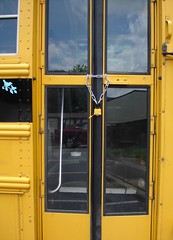
The first thing that stuck in my mind about the bus was the door. I could not get over how the door worked. So cool! It would fold up onto itself, roll along a little track, and collapse against one side of the doorway, in a motion so smooth it seemed futuristic. Then it would reverse itself seamlessly back into place.


The bus driver controlled it with a little handle she would crank from one side to the other and then back. I would watch the door operate at each stop. Open, Close. Why couldn’t all doors be like that? The closest I could find was our fireplace doors at home. I used to play with them a lot. A thing of beauty.


Before long, I memorized the route of my bus and the order of the stops. I learned everybody’s name and had a mental picture of their house, even if I’d never spoken to them directly. At the time, I could recite the list in order, and probably in reverse, too.


I used to ride my bike down the street and pretend I was a school bus. I had a fixed route I would take, every day, forward and back. Up the driveway, cutting across the lawn behind the bushes, down the sidewalk. Every now and then, coming to a stop. Turning my front wheel to the right, as if it was the door opening, and picturing the invisible kid getting on or off. Always at precisely the same places. Until I got to the “school,” which I think was the sandbox. I may have even had names for the “streets” and the “students” in my head.


I didn't have to venture too far, either. I remember there was one stretch where I would actually ride down the same part of the street twice, but the first time it was a neighborhood street, and I would go slow, and the other time it was the interstate and I would go fast!


I’m not sure what the neighbors thought to see me dutifully performing this complex ritual, punctuated by stops and starts, day in and day out. To me, it was fun, something to feel responsible for and to lose myself in for a little while. I never shared my activity with anyone else; it wouldn’t have been the same. Sure, I would ride bikes with my friends, but that was riding bikes. This was driving my bus route.

I used to wonder why I did such a thing. Now that I’ve learned about special interests, I can see I was fascinated with order and routine, to the point of repetitive adherence. Neighbors might have seen a peculiar boy tracing a overly consistent path with his bike, but in my mind, there was grand purpose to every twist and turn. If I didn’t follow my route, “my kids” wouldn’t get to “school!” Just like the real bus driver who picked me up every day. She got me there and back, safe and sound. Out of chaos, order.

And so I breezed through the childhood milestone of starting kindergarten, not with trepidation, but with wide-eyed curiosity. My Asperger’s was an obstacle in other ways, but here, it was an asset. It allowed me, through the guise of an intense interest, to concoct a coping strategy for a life transition. Now that I’m older, I hope this approach continues to serve me well. Perhaps in the face of uncertainty, instead of reacting with fear, I could embrace life’s changes as if gazing through the window, with my nose pressed up against the glass.


Photo credits:
Flickr creative commons by ashe-villain
Google Maps