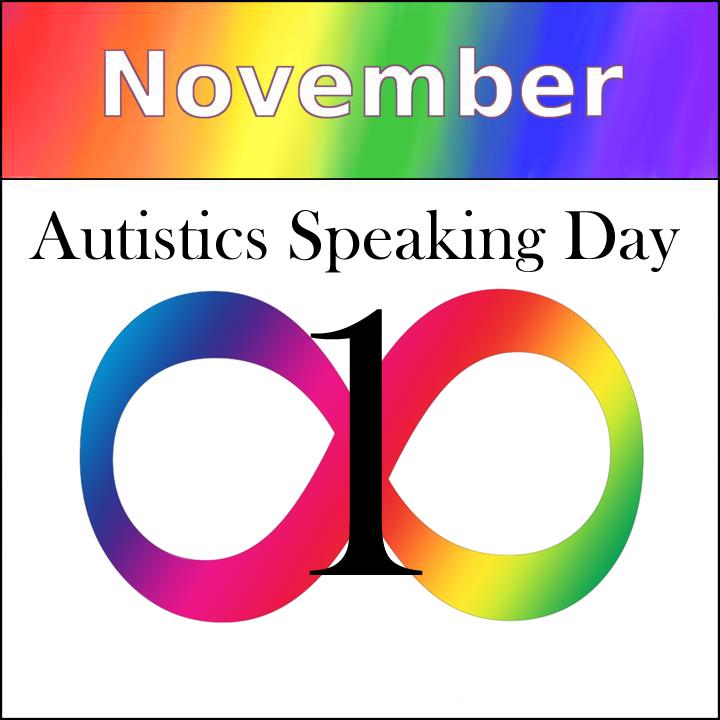
November 1 is the 4th Annual Autistics Speaking Day, and the word is beware. Beware! For here be monsters. On Halloween we celebrate imaginary monsters, but monsters are all too real in the world of autism. So too are the dangers they bring. If you want to speak up for autistic people, then speak out against these monsters.
(Inspired by Toby Allen’s Real Monsters.)
The Curebie Quacksalver
The Curebie insists autism can be cured, and his bag of tricks is full of deadly potions he’s willing to try on innocent test subjects. Treatments like bleach, or chelation. He cares not for any ill effects of his remedies, so convinced is he that the patient can “recover.” The idea of autism acceptance, he dismisses as laziness. The Curebie’s dogged persistence is rooted in his deep-seated hatred of autism.
The Denier Diablo
The Denier is learned in the dark arts, able to raise from the dead theories that have been scientifically banished, most notably a link between vaccines and autism. With one head perpetually buried in the sand, he ignores reality while cherry-picking statistics to support his outlandish claims. His other head wears a gas mask to guard against environmental toxins. The Denier is prone to tirades about the “truth” behind what causes autism. His arguments against vaccination risk reanimating the most lethal of all zombies, preventable disease, like measles.
The Celebrity Spellbinder
The Celebrity is the Big Cheese, the High Muckamuck, the Top Banana. But it’s her ideas about autism that are truly bananas. This behemoth personality uses her fame as a platform for pseudoscience, legitimizing what would otherwise be a fringe movement. She is known to distort or overgeneralize information, smearing the name of autistic people, falsely linking them to evils such as pedophilia. The Celebrity has blood on her hands from her ever-mounting body count of deaths and preventable illnesses suffered by her followers.
The Surrogate Silencer
The Surrogate fancies himself a spokesperson for the disabled, though not disabled himself. With his oversize megaphone, he readily raises his shrill voice over others, his loud volume justified (in his mind) by his advanced degree or job title. Not satisfied to drown out autistic voices, he would even silence them, through rules like “quiet hands.” The Surrogate is a skilled ghost-writer, churning out policies and fundraising appeals without representation from those he purports to serve! This specter’s menace is his denial of equal rights, like educational opportunities, or organ transplants, based on disability. He makes it about you, without you.
The Poison-Tongued Phantasm
The Poison-Tongue espouses vile, bigoted attitudes about autism, which she liberally dishes from behind the safety of her masked face. She harasses autistic people and their families with threatening letters slipped under doors, asking that they “do the right thing” and move, or put their child away somewhere permanent. The Poison-Tongue leaves in her wake the use of slurs like the R-word, poor grammar, and liberal use of exclamation points. She may hide her face, but never her forked tongue.
The Cold-Blooded Caregiver
The Caregiver who murders her autistic child has decided it is better to be dead than disabled. She believes herself an “angel of mercy” who is saving her child from suffering, when she has lost faith in supportive services and her own ability to cope. Many times, if only a true angel had intervened, her challenges and fears might have been properly addressed, before she acted out of desperation. Other times, she is purely selfish, focusing on her own stress instead of her child’s needs, even to the point of winning public sympathy for herself, with the life lost seen only as a footnote. What could be more monstrous?
Incredibly, all these real monsters of autism claim they are actually doing good. As long as these misconceptions persist, autistic people face real danger. This Autistics Speaking Day, let’s keep it real, and call a monster a monster.
Thoughts and illustrations on living on the autism spectrum.
Showing posts with label Autistics Speaking Day. Show all posts
Thursday, October 31, 2013
Thursday, November 1, 2012
Tiny Island
Today is the 3rd Annual Autistics Speaking Day. It also marks my third year of writing about autism. I have much to be thankful for this past year: the chance to create an animated short, to travel with the Juniper Hill crew, and to publish my second book. I am glad many of you continue to come here for laughs and insight. But often, when living with autism, there are no laughs or insight. The reality is that my daily life remains dominated by my inability to understand and coexist with other people.
I prefer to feel in control of my environment, and other people introduce chaos into it. They disrupt my equilibrium. They pop in and out, as it meets their needs and not mine. They are too fast, and too loud. Other autistic people are no easier for me to deal with than NT's. People irritate me. Or perhaps I irritate myself through my own discomfort and inability to articulate myself. Regardless, I find I deal best with others at a safe distance.
Most of my time is spent at the office or at home. I’m good at my job, and autism is a big reason for that. My work requires perfect accuracy, and perfection is what I deliver. I have a purpose in the workplace. I’ve learned the structure and I excel within it. It’s a foreign tongue sometimes, one that speaks with Important Words, like pursuant, and execute, and the delta, but I’ve become conversant in the language. I assimilate to ensure my survival.
Autistic people have no choice but to assimilate. Yet, we also desire to withdraw to our comfort zone, where we feel in control. This internal conflict threatens to drive us out of our minds, as Adam Bailey describes in a piece called Islands.
Leo Kottke sings in his song, “Tiny Island,”
I’ve grown less hopeful about autism acceptance by the greater community. I know the world will not change for me. So I have fewer laughs and insights to share with you in this space. A few successes doesn't make it easier to navigate a daily existence that drifts from mundane to chaotic. As Adam says, this is how I am, the real-life me. Man wasn’t meant to live on his own tiny island. So why does it seem so enticing?
I prefer to feel in control of my environment, and other people introduce chaos into it. They disrupt my equilibrium. They pop in and out, as it meets their needs and not mine. They are too fast, and too loud. Other autistic people are no easier for me to deal with than NT's. People irritate me. Or perhaps I irritate myself through my own discomfort and inability to articulate myself. Regardless, I find I deal best with others at a safe distance.
Most of my time is spent at the office or at home. I’m good at my job, and autism is a big reason for that. My work requires perfect accuracy, and perfection is what I deliver. I have a purpose in the workplace. I’ve learned the structure and I excel within it. It’s a foreign tongue sometimes, one that speaks with Important Words, like pursuant, and execute, and the delta, but I’ve become conversant in the language. I assimilate to ensure my survival.
Autistic people have no choice but to assimilate. Yet, we also desire to withdraw to our comfort zone, where we feel in control. This internal conflict threatens to drive us out of our minds, as Adam Bailey describes in a piece called Islands.
Our islands are awesome, but only to us. An island cannot simply fit into a school or workplace setting. Most others cannot feel comfortable on our islands, because it is so odd there. We cannot feel comfortable leaving our islands for very long, because it is so odd outside them.Maybe in the workplace, assimilation is easier, because I have a clearly defined role. Maybe those of you who share a household also find it a comfortable fit, within easily definable parameters. But outside of familiar environments, there are simply too many unknowns. At times, sanity demands avoiding such uncertainty.
It takes a perfect balance all the time in order to get by, and as soon as we stop working as hard, things get really difficult really quick.
Leo Kottke sings in his song, “Tiny Island,”
I wish I had a tiny island floating in the sea.Given the option, I believe I would cast off the civilized life for my own tiny island. I find solitude the most comfortable state, and increasingly, my lifestyle leaves no room for others.
Palm trees sway, don't get in the way, it's a tropical ease.
And everywhere that I keep my silence, no sound returns to me.
Just endless waves at the end of our days, the sighing of the seas.
I’ve grown less hopeful about autism acceptance by the greater community. I know the world will not change for me. So I have fewer laughs and insights to share with you in this space. A few successes doesn't make it easier to navigate a daily existence that drifts from mundane to chaotic. As Adam says, this is how I am, the real-life me. Man wasn’t meant to live on his own tiny island. So why does it seem so enticing?
Labels:
autism,
Autistics Speaking Day,
employment,
leo kottke
Tuesday, November 1, 2011
Chasing Typical
Today is the 2nd Annual Autistics Speaking Day, a day for those of us on the spectrum to make our voices heard, to raise awareness, and to self-advocate through blogs and social media. If you’re a first-time reader, welcome. I encourage you to read as many points of view as possible today. Then, if you wish, join me in turning your support into action, by making a charitable donation to an autism organization of your choice, such as ASAN.
This is a day for autistic pride. We have so many reasons to be proud. Yet it remains difficult to be as proud as we should. Because for all the awareness we raise, we still feel like aliens on this planet. We do not fit in. It is hard to be proud, when many of us carry with us a sense of shame. If you are a neurotypical (NT), I would like you to understand where this shame comes from. Because every day, however unintentionally or implicitly, you expect us to behave as neurotypicals do. This is an expectation we cannot meet.
I have been told, throughout my life, I have so much potential. I could do so much more. If only I would learn to be more outgoing. I heard it as a child, before anyone knew I was autistic. I still hear it as an adult, from people who know I am an Aspie.
In school, I was an A student. I had “outstanding” math ability, “far exceeded my peers” in grammar, and was “a prepared and excellent test-taker.” In art class, my teacher said of my talent, “Such expressions of beauty and acute perception reveal a mind and soul of rare sensitivity.”
I was a good student. Good, but not good enough.
I would not take part in class discussions, they said, because I “found the contradiction or assent of others too risky.”
I had made “a decision to not communicate orally,” which “stifled my development.”
I was “unmotivated” to discuss class material, “refused to get involved,” and “had no debating skills other than with pen in hand.”
I was disruptive, disrespectful, and a discipline problem.
Consider the effect of such criticism on a middle school age child who was also a victim of bullying by his peers. It was for my own good, they said. These flaws would hold me back in life, and what a shame that would be.
“I can’t do what you ask,” I told them.
“Not can’t,” they said. “Won’t.”
They were so sure. Scornful, even. As if my choice was obvious. As if I was sitting on a treasure chest full of potential, and chose not to unlock it to see what was inside.
No one had heard of Asperger’s back then. But I suspected that I was different. There had to be some reason I could not do these things others found so basic. It would be some 20 years before autism gave it a name.
But at the time, I could not help but develop a sense of self-doubt. A sense I would never be good enough. A sense of shame.
As an adult, learning about the autism spectrum lessened this burden somewhat, but not completely. Our world is an NT world. It will always be an NT yardstick we are measured by. Our world values smiles, phone conversations, small talk, and fitting in with the group. It values extroverts.
As an adult, I continue to receive constructive criticism, well-intentioned, to help me reach my potential. I’m not enough of a leader. I’m not assertive enough. Not engaging or friendly enough. It still hits like a punch in the gut.
I can explain now, that I am autistic, and I may not meet these expectations. I am glad to say people are more understanding, when they know. It still bothers me though, to fall short. It hurts to have to say, “I’m sorry, I can’t do what you ask.” Not because I am defiant, or think I am special, or know better than you, or am not trying. I am differently abled, though I may not look it. “Different, not less,” is still a long way from being reality.
I’m reminded in indirect ways, too, that I fall short of the NT ideal. I’m reminded, every time your conversation swirls around me, and I’m not a part. I’m reminded, when you can’t read my mood by my expression. I’m reminded, in your moment of surprise that I didn’t anticipate what you were thinking. I look like you, but I do the unexpected. I can confuse you, and I feel guilty for that.
I also must allow for the possibility that in fact, I can, and should, be working to improve my social weaknesses. Everyone is capable of self-improvement. I don’t believe being an Aspie should give me a "free pass" against anything I find too hard. Could I be a leader if I tried? Could I have better phone skills? I don’t know. I’m not sure where the line is between “can’t” and “won’t.”
On this Autistics Speaking Day, my hope is that by sharing my point of view, NT’s may understand why I will not always meet your expectations. As one of my readers recently put it, “Too many people are not aware of how far out of our ‘skin’ we go to do things sometimes. Some of them don't realize how it is to push yourself on things that come easy for them.”
It will always be an NT world. Despite the progress we have made in autism awareness and education, I still feel that I am “chasing typical,” looking for something more that will “complete” me. Is there more of my potential inside that locked chest? Or is there nothing but an empty box? Maybe all that potential is already here, outside the box. Maybe I am squandering what I already do best, in chasing after something more that might be inside.
My hope is that a day will come when I no longer have to compare myself to the NT ideal. When I can stop chasing after what I can’t do, and start going full speed ahead at what I can do well. When I am truly free to be different, not less.
To read more posts from participants in Autistics Speaking Day, please visit the AS Day blog or Facebook page.
This is a day for autistic pride. We have so many reasons to be proud. Yet it remains difficult to be as proud as we should. Because for all the awareness we raise, we still feel like aliens on this planet. We do not fit in. It is hard to be proud, when many of us carry with us a sense of shame. If you are a neurotypical (NT), I would like you to understand where this shame comes from. Because every day, however unintentionally or implicitly, you expect us to behave as neurotypicals do. This is an expectation we cannot meet.
I have been told, throughout my life, I have so much potential. I could do so much more. If only I would learn to be more outgoing. I heard it as a child, before anyone knew I was autistic. I still hear it as an adult, from people who know I am an Aspie.
In school, I was an A student. I had “outstanding” math ability, “far exceeded my peers” in grammar, and was “a prepared and excellent test-taker.” In art class, my teacher said of my talent, “Such expressions of beauty and acute perception reveal a mind and soul of rare sensitivity.”
I was a good student. Good, but not good enough.
I would not take part in class discussions, they said, because I “found the contradiction or assent of others too risky.”
I had made “a decision to not communicate orally,” which “stifled my development.”
I was “unmotivated” to discuss class material, “refused to get involved,” and “had no debating skills other than with pen in hand.”
I was disruptive, disrespectful, and a discipline problem.
Consider the effect of such criticism on a middle school age child who was also a victim of bullying by his peers. It was for my own good, they said. These flaws would hold me back in life, and what a shame that would be. “I can’t do what you ask,” I told them.
“Not can’t,” they said. “Won’t.”
They were so sure. Scornful, even. As if my choice was obvious. As if I was sitting on a treasure chest full of potential, and chose not to unlock it to see what was inside.
No one had heard of Asperger’s back then. But I suspected that I was different. There had to be some reason I could not do these things others found so basic. It would be some 20 years before autism gave it a name.
But at the time, I could not help but develop a sense of self-doubt. A sense I would never be good enough. A sense of shame.
As an adult, learning about the autism spectrum lessened this burden somewhat, but not completely. Our world is an NT world. It will always be an NT yardstick we are measured by. Our world values smiles, phone conversations, small talk, and fitting in with the group. It values extroverts.
As an adult, I continue to receive constructive criticism, well-intentioned, to help me reach my potential. I’m not enough of a leader. I’m not assertive enough. Not engaging or friendly enough. It still hits like a punch in the gut.
I can explain now, that I am autistic, and I may not meet these expectations. I am glad to say people are more understanding, when they know. It still bothers me though, to fall short. It hurts to have to say, “I’m sorry, I can’t do what you ask.” Not because I am defiant, or think I am special, or know better than you, or am not trying. I am differently abled, though I may not look it. “Different, not less,” is still a long way from being reality.
I’m reminded in indirect ways, too, that I fall short of the NT ideal. I’m reminded, every time your conversation swirls around me, and I’m not a part. I’m reminded, when you can’t read my mood by my expression. I’m reminded, in your moment of surprise that I didn’t anticipate what you were thinking. I look like you, but I do the unexpected. I can confuse you, and I feel guilty for that.
I also must allow for the possibility that in fact, I can, and should, be working to improve my social weaknesses. Everyone is capable of self-improvement. I don’t believe being an Aspie should give me a "free pass" against anything I find too hard. Could I be a leader if I tried? Could I have better phone skills? I don’t know. I’m not sure where the line is between “can’t” and “won’t.”On this Autistics Speaking Day, my hope is that by sharing my point of view, NT’s may understand why I will not always meet your expectations. As one of my readers recently put it, “Too many people are not aware of how far out of our ‘skin’ we go to do things sometimes. Some of them don't realize how it is to push yourself on things that come easy for them.”
It will always be an NT world. Despite the progress we have made in autism awareness and education, I still feel that I am “chasing typical,” looking for something more that will “complete” me. Is there more of my potential inside that locked chest? Or is there nothing but an empty box? Maybe all that potential is already here, outside the box. Maybe I am squandering what I already do best, in chasing after something more that might be inside.
My hope is that a day will come when I no longer have to compare myself to the NT ideal. When I can stop chasing after what I can’t do, and start going full speed ahead at what I can do well. When I am truly free to be different, not less.
To read more posts from participants in Autistics Speaking Day, please visit the AS Day blog or Facebook page.
Labels:
advocacy,
asperger's,
autism,
Autistics Speaking Day,
neurodiversity
Monday, November 1, 2010
Autistics Speaking Day: The Path to Understanding
Today is Autistics Speaking Day, a counter-campaign to the Communication Shutdown. If you’re a first time visitor to my blog, welcome! I’m glad you stopped by.
I disagree with the message of the Shutdown. But I still support you if you’re taking part, because we need awareness and funds raised by any means (that don’t disregard autism facts and science).
I am speaking out, 1) with today’s post, 2) by sharing some of my favorite links on Facebook and Twitter, and 3) by encouraging you to make a charitable donation to an autism organization of your choice. I am supporting my local agency Autism Delaware through my annual United Way contribution. I also recommend GRASP, the Global and Regional Asperger Syndrome Partnership.
I want to begin with a few words about social media. Yes, shutting down your social media for a day draws attention to a cause. No, it does not help you understand how it feels to be autistic. Ironically, you can get perhaps the best explanations of autism via social media.
My own cartoon, Dude, I’m An Aspie! owes its success to social media. And by success, I don’t mean hits, or dollars, but understanding. The project was conceived as a Facebook photo album to disclose to my friends, and nothing more. By happy coincidence, I posted it exactly one year ago today, 11/1/09. Here are some of the comments my friends made:
“I really enjoyed reading this and learned a lot.”
“Now I understand better, thank you!”
“Very illuminating. Thank you for sharing.”
It was a heartening feeling. I went on to share the cartoon in online Asperger’s communities, to continued praise.
“Wow, does that ever define me.”
“One of the best ways of explaining AS I've ever read.”
“I've saved a copy to possibly use with my students in the future.”
And from there, "Dude" became a blog, and then a book. So without social media, there would be no "Dude, I’m An Aspie!" How else would I have disclosed if I could not have done it through cartoons? “Um, excuse me, there’s something I need to tell you about myself…” It’s more likely I would not have disclosed at all.
Instead, I’ve done it coherently, confidently, and humorously. Many others have used my cartoon for their disclosure. Over 1,300 individuals have visited my blog in the past 3 months. Indeed, for many of us on the spectrum, social media is truly our comfort zone. It would be unthinkable to shut that down.
I wish you could understand what it’s like to be me. I wish shutting down your social network for a day would do it. I wish my cartoons would do it, but even that gives you just a small glimpse. And just by listening to me does not mean you understand autism.
This is called Autistics Speaking Day, but I don’t speak for autistics. I speak for myself, and that’s the best I can do. None of us can speak for all of us. The autism blogosphere is richly diverse. We are the pro-cure and the pro-neurodiversity, the nonverbal and the Aspies, the diagnosed and the self-identified. We often disagree, to put it mildly.
Among us are bloggers who have viciously attacked others as “faux autistics” because they can hold down a job, act natural on camera, or dare to align themselves with the dreaded Autism Speaks. At the other end of the spectrum are bloggers who are happily married with families, and are published authors, or eloquent speakers. Both get under my skin for very different reasons. But I would not silence any of their voices. We need to hear from them all, and I include in “we” the autistic community as well as neurotypicals. Kathleen Leopold and Kim Wombles of the Autism Blogs Directory said it best:
“We are a community; we share common bonds and common ground, and we need, even as we disagree, to remember this. Because if we don't, we destroy what common ground we have.”
I think no statement better describes my hopes for Autistics Speaking Day. It explains why I also support the Shutdown. I have only been an autism advocate for about a year, but I have worked in the non-profit arena for nearly a decade. If you want to bring about change for an issue as complex as autism, you must build consensus and respect diversity. Anger and infighting will get you nowhere. The hostility and name-calling I’ve seen from both sides around the Shutdown and Autistics Speaking is shameful, and nauseating.
Which brings us back to the question, how can you understand autism? When you’ve met one autistic, you’ve met one autistic. Is understanding even possible with such diversity? I think so, and here’s how:
You can never understand us as a block, by lumping us all together. Only as individuals. I think that goes for understanding people. Not just autistic people, but gay people, or Tea Party people, or Muslim people, or whatever. Sit down, open your mind, and listen to us one at a time. That’s the best you can do.
So I encourage you, after you’ve visited my blog, to check out other voices in our community. If you see something you like, leave a comment, or share it with your social network. If you’re inclined to donate to a helping organization, thank you. And I hope you’ll stay connected with our community. We need as many voices as we can get, contributing to a passionate, educated, civil discourse about autism. That is the path to understanding.
Welcome.
I disagree with the message of the Shutdown. But I still support you if you’re taking part, because we need awareness and funds raised by any means (that don’t disregard autism facts and science).
I am speaking out, 1) with today’s post, 2) by sharing some of my favorite links on Facebook and Twitter, and 3) by encouraging you to make a charitable donation to an autism organization of your choice. I am supporting my local agency Autism Delaware through my annual United Way contribution. I also recommend GRASP, the Global and Regional Asperger Syndrome Partnership.
I want to begin with a few words about social media. Yes, shutting down your social media for a day draws attention to a cause. No, it does not help you understand how it feels to be autistic. Ironically, you can get perhaps the best explanations of autism via social media.
My own cartoon, Dude, I’m An Aspie! owes its success to social media. And by success, I don’t mean hits, or dollars, but understanding. The project was conceived as a Facebook photo album to disclose to my friends, and nothing more. By happy coincidence, I posted it exactly one year ago today, 11/1/09. Here are some of the comments my friends made:
“I really enjoyed reading this and learned a lot.”
“Now I understand better, thank you!”
“Very illuminating. Thank you for sharing.”
It was a heartening feeling. I went on to share the cartoon in online Asperger’s communities, to continued praise.
“Wow, does that ever define me.”
“One of the best ways of explaining AS I've ever read.”
“I've saved a copy to possibly use with my students in the future.”
And from there, "Dude" became a blog, and then a book. So without social media, there would be no "Dude, I’m An Aspie!" How else would I have disclosed if I could not have done it through cartoons? “Um, excuse me, there’s something I need to tell you about myself…” It’s more likely I would not have disclosed at all.
Instead, I’ve done it coherently, confidently, and humorously. Many others have used my cartoon for their disclosure. Over 1,300 individuals have visited my blog in the past 3 months. Indeed, for many of us on the spectrum, social media is truly our comfort zone. It would be unthinkable to shut that down.
I wish you could understand what it’s like to be me. I wish shutting down your social network for a day would do it. I wish my cartoons would do it, but even that gives you just a small glimpse. And just by listening to me does not mean you understand autism.
This is called Autistics Speaking Day, but I don’t speak for autistics. I speak for myself, and that’s the best I can do. None of us can speak for all of us. The autism blogosphere is richly diverse. We are the pro-cure and the pro-neurodiversity, the nonverbal and the Aspies, the diagnosed and the self-identified. We often disagree, to put it mildly.
Among us are bloggers who have viciously attacked others as “faux autistics” because they can hold down a job, act natural on camera, or dare to align themselves with the dreaded Autism Speaks. At the other end of the spectrum are bloggers who are happily married with families, and are published authors, or eloquent speakers. Both get under my skin for very different reasons. But I would not silence any of their voices. We need to hear from them all, and I include in “we” the autistic community as well as neurotypicals. Kathleen Leopold and Kim Wombles of the Autism Blogs Directory said it best:
“We are a community; we share common bonds and common ground, and we need, even as we disagree, to remember this. Because if we don't, we destroy what common ground we have.”I think no statement better describes my hopes for Autistics Speaking Day. It explains why I also support the Shutdown. I have only been an autism advocate for about a year, but I have worked in the non-profit arena for nearly a decade. If you want to bring about change for an issue as complex as autism, you must build consensus and respect diversity. Anger and infighting will get you nowhere. The hostility and name-calling I’ve seen from both sides around the Shutdown and Autistics Speaking is shameful, and nauseating.
Which brings us back to the question, how can you understand autism? When you’ve met one autistic, you’ve met one autistic. Is understanding even possible with such diversity? I think so, and here’s how:
You can never understand us as a block, by lumping us all together. Only as individuals. I think that goes for understanding people. Not just autistic people, but gay people, or Tea Party people, or Muslim people, or whatever. Sit down, open your mind, and listen to us one at a time. That’s the best you can do.
So I encourage you, after you’ve visited my blog, to check out other voices in our community. If you see something you like, leave a comment, or share it with your social network. If you’re inclined to donate to a helping organization, thank you. And I hope you’ll stay connected with our community. We need as many voices as we can get, contributing to a passionate, educated, civil discourse about autism. That is the path to understanding.
Welcome.
Labels:
advocacy,
asperger's,
autism,
Autistics Speaking Day
Subscribe to:
Posts (Atom)