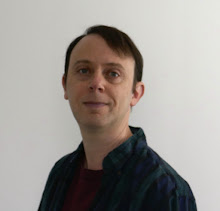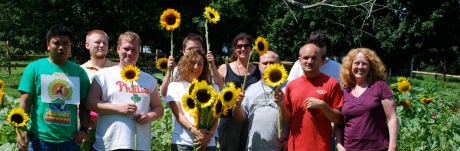
I’ve met some very cool people through this blog, but perhaps the most awesome of them all have been right in my own backyard. Juniper Hill Farms is an independent living community of adults on the autism spectrum. These folks found me a few months ago, by way of thAutcast. We got to messaging, and turns out, they’re only a 20 minute drive from my house. So I went out to see them!
Juniper Hill consists of Diane Belnavis’s farm, her six tenants, their support people, and lots of animals. It’s not a licensed facility or a group home; it’s simply a household of people living and working together. All the residents are either on the autism spectrum or have another disability. Most are in their early 20’s and need assistance to live independently. They work on the farm, pay rent, and receive assistance from their support people several times a week.
Diane’s background is in the disabilities field, and she currently works as Housing Director for a local agency. Juniper Hill was a project she started about a year ago, as something she always dreamed of doing. Her adopted son Brent, who has autism, has lived with her family for thirty years. Juniper Hill applies her knowledge of what works, based on that professional and life experience. Her own role is one she describes as "bossy big sister," but that doesn't really do it justice. What she has built is simply incredible.
It is a real mix of personalities on the farm, and everyone's differences have been the greatest challenge, Diane explained to me. Some of the guys are quite talkative, some not so much. Interests and hobbies vary greatly, from Star Wars to Halo to Barbie. It didn't always go smoothly during the first year. Everyone needed to just get used to one another, but now, Diane says they get along really well. Now, they do much more cooking, and much less arguing.The guys all want to tell their stories too, which they are doing through their own pages on the Juniper web site.
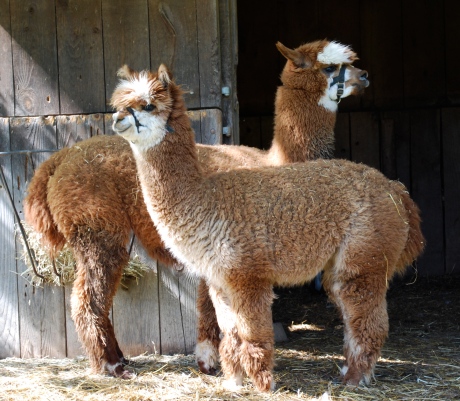
As for the animals, there are alpacas, which are used for fiber, cashmere goats, and big fluffy angora rabbits. There are the exotic and very loud guinea hens. And some chickens, and sheep, and pot bellied pigs, and an emu, and Kit the Chihuahua, who followed us everywhere. Feeding time is best observed from a safe distance outside the pen, because they all tend to go nutso for food.
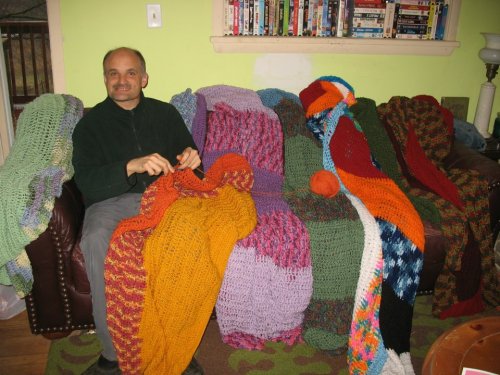
Inside the house, a fire is going, DVD's line the wall, and a pool table is covered in figurines and Lego. Brent’s specialty is crocheting blankets, which he sells through Blankets by Brent. Dude is fast, too! He hands me a ball of yarn and motions for me to hold it while he works. I quickly find myself unwinding and unwinding continuously to keep up with him.
In the spring they’ll be planting sunflowers to sell, making birdhouses, and much more. On weekends they often have social activities, such as today's Harlem Globetrotters game which they received donated tickets for. Sunday dinner is one of the highlights of each week. Diane has all kinds of big dreams for the place. You can read all about it on her excellent blog. Very exciting stuff.
I’ve started to visit the farm once a week or so, to see where I can help out. It’s been great fun so far, and remarkable to see all that goes on. It's a place filled with stories, and I've only just begun to scratch the surface. But it's made quite an impression on me in a short time. It strikes me a peaceful place where people are allowed to just be who they are, and coexist with others who are very different.
"It just works…" Diane says. "We didn’t plan to not have a plan… it is just evolving this way." It’s that simple.
And hey, one more thing... if you need any further proof of how awesome this place is, Juniper Hill was where this Animal Collective video was filmed a few years ago. (Before a rehab project on the house, much needed after all the splattered paint and eggs!)
Photos belong to juniperhillfarms.org.
Thoughts and illustrations on living on the autism spectrum.
Showing posts with label disabilities. Show all posts
Sunday, March 11, 2012
Sunday, October 10, 2010
The Village of Disappearing Differences
Imagine, if you will, a residential home for autistic adults, but instead of an institutional building, a 400 acre farm. And instead of a paid staff of aides on rotating shifts, care is provided by fellow residents who live full time on site. And instead of sitting in a room in front of a large TV, the residents spend their days at work in the gardens, or baking bread, or weaving rugs, producing retail goods they sell for profit.
An idealistic pipe dream? Something out of fiction? Nope, it’s the real thing. I had occasion recently to learn about the Camphill movement. I found it compelling, curious, and inspiring, and I wanted to share with you what I learned.
Camphill villages are farming and handcrafting communities that include adults with developmental disabilities, such as autism and Down syndrome. The model was developed in 1939 by Karl Koenig, and today there are more than 100 communities worldwide. Central to the concept is anthroposophy, the idea of respect for the spiritual wholeness of each person and the human possibilities to evolve toward freedom and love.
Non-disabled resident volunteers live and work side by side with those with special needs. Some stay a year as part of an AmeriCorps-type program; others stay for years or a lifetime. They share meals and household responsibilities. The village sells its organic produce, baked goods, and crafts at a café open to the public, and at Whole Foods. They host concerts and festivals. There’s also the Waldorf school branch of Camphill, serving children with special needs. And, if that all wasn’t enough, all Camphill technology is green, from the sustainable agriculture to the construction of the residences.
Are you a bit awe-struck? I must say I am. Here's a relatively little-known organization with progressive solutions to many of our most challenging societal problems, all in one place. Perhaps most impressive is that the abled and disabled are treated as equals. We often say that’s what we most wish for, for autistic persons, the disappearance of different-ness. Camphill is a community in the realest sense. “I stopped seeing people with disabilities, and now I just see people,” commented one service volunteer in the recent Camphill publication, Lilipoh.
Why isn’t Camphill better known? It seems positively utopian in its outlook, and at the same time, somewhat radical. The villages are not licensed treatment facilities. They are supported by donations, grants, sales, and family support. They don’t collect detailed data on outcomes for residents and whether their lives improve. Despite the 70-year history of the movement, there seems to be no scientific comparison with traditional group homes. Indeed, little evidence suggests Camphill does a better job at caring for the disabled.
“The Camphill communities… are widely known of, but little known about; often lauded, sometimes condemned but rarely understood,” according to a review by Baron and Haldane (1991). A study of the 600 Waldorf schools worldwide found “there appears to be no research based evidence to its effectiveness for those with autism or other developmental disability.” (Roberts 2004) Most recently, a study in Ireland compared 29 residents of a Camphill community with 125 residents of a traditional group home. Camphill was found to have higher staff:resident ratios, more homely living areas, and less of an institutional feel, but was not found to be better on a range of other objective measures (Fahey et al. 2010).
So without scientific proof of effectiveness (or ineffectiveness), it seems that further comparative studies should be done. If the Camphill model could gain evidence-based status, then it could expand beyond its seven sites in the U.S. If it has weaknesses, then researchers could work toward improving the model. At a time when residential homes are needed, expensive, and challenging to operate, we should fully investigate promising alternative models.
Whether or not that happens, the Camphill movement remains fascinating. I plan to keep attuned to the goings-on at my local Camphill branch in Kimberton, PA, perhaps check out a musical performance or pick up some freshly baked cookies at the café. It might be nice to volunteer for a day, get a window into a different rhythm of life, where the food is slow, the workers are like family, and the boundaries between us disappear. If you have the chance to visit a village, I hope you will, too.
For more information, visit camphill.org.
Photo credits: Photo 1 - Wikimedia Commons. Photo 2 - Copyright Lizzie and licensed for reuse under this Creative Commons License
An idealistic pipe dream? Something out of fiction? Nope, it’s the real thing. I had occasion recently to learn about the Camphill movement. I found it compelling, curious, and inspiring, and I wanted to share with you what I learned.
Camphill villages are farming and handcrafting communities that include adults with developmental disabilities, such as autism and Down syndrome. The model was developed in 1939 by Karl Koenig, and today there are more than 100 communities worldwide. Central to the concept is anthroposophy, the idea of respect for the spiritual wholeness of each person and the human possibilities to evolve toward freedom and love.
Non-disabled resident volunteers live and work side by side with those with special needs. Some stay a year as part of an AmeriCorps-type program; others stay for years or a lifetime. They share meals and household responsibilities. The village sells its organic produce, baked goods, and crafts at a café open to the public, and at Whole Foods. They host concerts and festivals. There’s also the Waldorf school branch of Camphill, serving children with special needs. And, if that all wasn’t enough, all Camphill technology is green, from the sustainable agriculture to the construction of the residences.
Are you a bit awe-struck? I must say I am. Here's a relatively little-known organization with progressive solutions to many of our most challenging societal problems, all in one place. Perhaps most impressive is that the abled and disabled are treated as equals. We often say that’s what we most wish for, for autistic persons, the disappearance of different-ness. Camphill is a community in the realest sense. “I stopped seeing people with disabilities, and now I just see people,” commented one service volunteer in the recent Camphill publication, Lilipoh.
Why isn’t Camphill better known? It seems positively utopian in its outlook, and at the same time, somewhat radical. The villages are not licensed treatment facilities. They are supported by donations, grants, sales, and family support. They don’t collect detailed data on outcomes for residents and whether their lives improve. Despite the 70-year history of the movement, there seems to be no scientific comparison with traditional group homes. Indeed, little evidence suggests Camphill does a better job at caring for the disabled.
“The Camphill communities… are widely known of, but little known about; often lauded, sometimes condemned but rarely understood,” according to a review by Baron and Haldane (1991). A study of the 600 Waldorf schools worldwide found “there appears to be no research based evidence to its effectiveness for those with autism or other developmental disability.” (Roberts 2004) Most recently, a study in Ireland compared 29 residents of a Camphill community with 125 residents of a traditional group home. Camphill was found to have higher staff:resident ratios, more homely living areas, and less of an institutional feel, but was not found to be better on a range of other objective measures (Fahey et al. 2010).
So without scientific proof of effectiveness (or ineffectiveness), it seems that further comparative studies should be done. If the Camphill model could gain evidence-based status, then it could expand beyond its seven sites in the U.S. If it has weaknesses, then researchers could work toward improving the model. At a time when residential homes are needed, expensive, and challenging to operate, we should fully investigate promising alternative models.
Whether or not that happens, the Camphill movement remains fascinating. I plan to keep attuned to the goings-on at my local Camphill branch in Kimberton, PA, perhaps check out a musical performance or pick up some freshly baked cookies at the café. It might be nice to volunteer for a day, get a window into a different rhythm of life, where the food is slow, the workers are like family, and the boundaries between us disappear. If you have the chance to visit a village, I hope you will, too.
For more information, visit camphill.org.
Photo credits: Photo 1 - Wikimedia Commons. Photo 2 - Copyright Lizzie and licensed for reuse under this Creative Commons License
Labels:
autism,
camphill,
disabilities,
volunteers
Tuesday, September 21, 2010
Tourettes Karaoke: Is It OK To Laugh?
Tourettes Karaoke is the latest viral video making the rounds. Guy, the star performer, tarot card reader, poet, etc., has high functioning autism as well as Tourette’s. His obscentity-laden take on REM’s “Losing My Religion” is a riot. And, it raises questions both uncomfortable and important.
The most basic question: Is it okay to laugh? I know I did. Guy seems to be giving us an open invitation to do just that. Is there any doubt he’s in on the joke? His choice of “Losing My Religion” for his interjected f-bombs makes for a brilliant skewering of this oh-so-self-important REM hit. Here’s someone who sees the humor in his hardship and a purpose in putting himself on display.
The Osocio blog, which showcases noteworthy non-profit marketing campaigns, theorizes about that purpose. Blog author Marc van Gurp says Guy deserves respect for what he’s doing. He argues Tourettes Karaoke will reach a larger audience than any professional awareness campaign about Tourette’s. If that audience sees Tourette’s -- and autism -- humanized through Guy’s self-deprecating humor, perhaps it will lessen their fear and increase their compassion for those affected.
But maybe, you’re thinking, no, this is offensive. Just another idiot. Part of the problem, by encouraging us to laugh at the disabled. But if you do believe that, then is Guy any worse than the countless neurotypicals out there who subject us to their awful karaoke for yuks? (William Hung, anyone?) Hasn’t he got a right to make a fool of himself too? After all, he is as much a flawed human as any of us.
Now if it were an intellectually disabled person doing this, things would be different. Laughing would not be okay. Even Vote For the Worst draws the line at criticizing the American Idol rejects who are clearly lacking in intellectual faculties.
And where does autism fit into this? Tourette’s is Guy’s visible disability here, and it’s the tics that tickle the funny bone. There’s a reason it’s not called Autism Karaoke. But it doesn’t mean some fearless autistic couldn’t do what Guy did, and produce their own better-than-the-original REM cover. How about karaoke with stims?
I’ve personally never been one to make jokes at my expense, and I confess have trouble understanding what motivates others to do it. I feel a bit uncomfortable for Guy, and yet I do find him entertaining, and deserving of respect, whatever his motives. I think it is a healthy and humanizing thing to laugh at ourselves. More often than not, we get our guard up in response to differences – we discriminate, ridicule, or just walk on eggshells. Laughing along with those who are different, rather than at them, disarms our fear.
So go ahead. Laugh. It’s okay.
The most basic question: Is it okay to laugh? I know I did. Guy seems to be giving us an open invitation to do just that. Is there any doubt he’s in on the joke? His choice of “Losing My Religion” for his interjected f-bombs makes for a brilliant skewering of this oh-so-self-important REM hit. Here’s someone who sees the humor in his hardship and a purpose in putting himself on display.
The Osocio blog, which showcases noteworthy non-profit marketing campaigns, theorizes about that purpose. Blog author Marc van Gurp says Guy deserves respect for what he’s doing. He argues Tourettes Karaoke will reach a larger audience than any professional awareness campaign about Tourette’s. If that audience sees Tourette’s -- and autism -- humanized through Guy’s self-deprecating humor, perhaps it will lessen their fear and increase their compassion for those affected.
But maybe, you’re thinking, no, this is offensive. Just another idiot. Part of the problem, by encouraging us to laugh at the disabled. But if you do believe that, then is Guy any worse than the countless neurotypicals out there who subject us to their awful karaoke for yuks? (William Hung, anyone?) Hasn’t he got a right to make a fool of himself too? After all, he is as much a flawed human as any of us.
Now if it were an intellectually disabled person doing this, things would be different. Laughing would not be okay. Even Vote For the Worst draws the line at criticizing the American Idol rejects who are clearly lacking in intellectual faculties.
And where does autism fit into this? Tourette’s is Guy’s visible disability here, and it’s the tics that tickle the funny bone. There’s a reason it’s not called Autism Karaoke. But it doesn’t mean some fearless autistic couldn’t do what Guy did, and produce their own better-than-the-original REM cover. How about karaoke with stims?
I’ve personally never been one to make jokes at my expense, and I confess have trouble understanding what motivates others to do it. I feel a bit uncomfortable for Guy, and yet I do find him entertaining, and deserving of respect, whatever his motives. I think it is a healthy and humanizing thing to laugh at ourselves. More often than not, we get our guard up in response to differences – we discriminate, ridicule, or just walk on eggshells. Laughing along with those who are different, rather than at them, disarms our fear.
So go ahead. Laugh. It’s okay.
Labels:
autism,
disabilities,
music
Subscribe to:
Posts (Atom)